


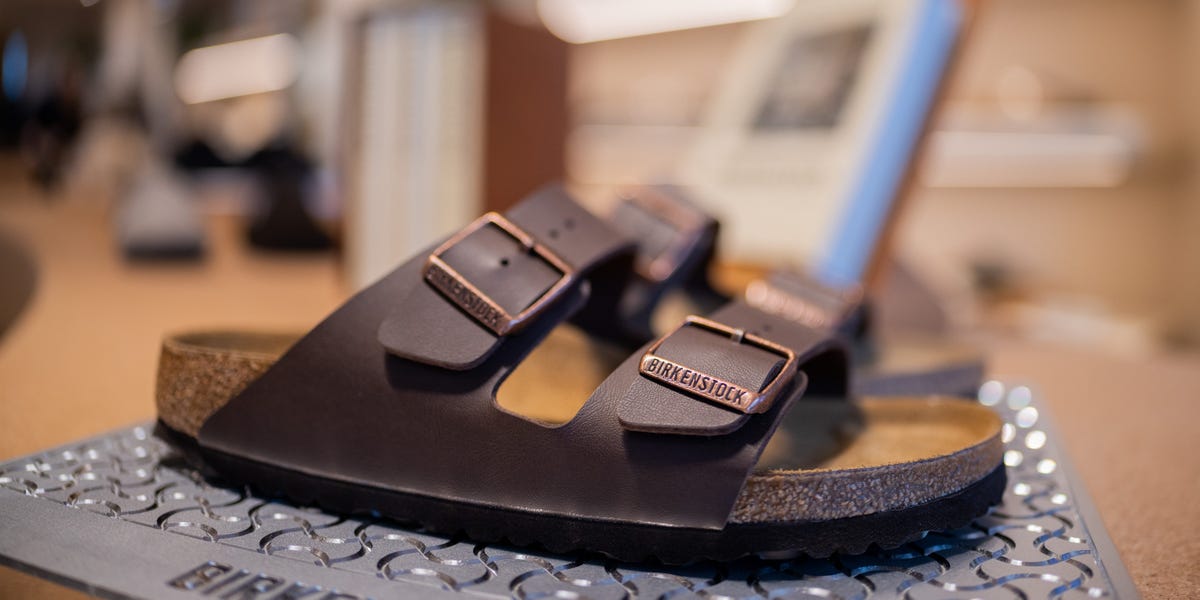
Birkenstock to Adjust Prices in Response to Tariff Pressures
To counteract the economic impact of tariffs imposed by President Donald Trump, Birkenstock announces plans to increase its footwear prices globally.
On a recent earnings call held on Thursday, company representatives discussed their strategy for upcoming price adjustments.
Ivica Krolo, who leads the company's financial operations, explained that a 'modest single-digit increase across the globe' is essential to completely neutralize the tariff effects.
Krolo noted the company's reduced exposure to tariff-related costs due to their entirely European-based production and the sourcing of 96% of materials from Europe, eliminating manufacturing contracts in Asia.
As stated on April 2, Trump's policy dictates a 10% tariff on all goods entering the United States, which would include an extra 10% for items from the European Union under 'reciprocal' considerations.
However, Trump later announced a temporary 90-day suspension on these additional tariffs to allow for trade talks.
Krolo assured that the tariff situation in the US would not affect Birkenstock’s international pricing system. Popular models like the Arizona and Boston retain their $150 price point.
She confirmed that the tariff effects are being mitigated globally, rather than adjusting prices regionally, emphasizing a unified approach.
Besides raising prices, Birkenstock is exploring efficiencies in its production processes and negotiating with suppliers as ways to further counteract the tariff impact.
Queries about specific price increases, timing, and the specific models affected remain unanswered by Birkenstock representatives.
The company reported a notable revenue surge, experiencing a 19% increase in their latest quarter, translating to sales of €574.3 million, or approximately $643.2 million.
A substantial portion of these sales, €312.5 million, originated from the Americas.
The second-largest revenue source was the combined markets of Europe, the Middle East, and Africa, which brought in €212.8 million, followed by the Asia Pacific at €47.8 million.
Leave a Reply