


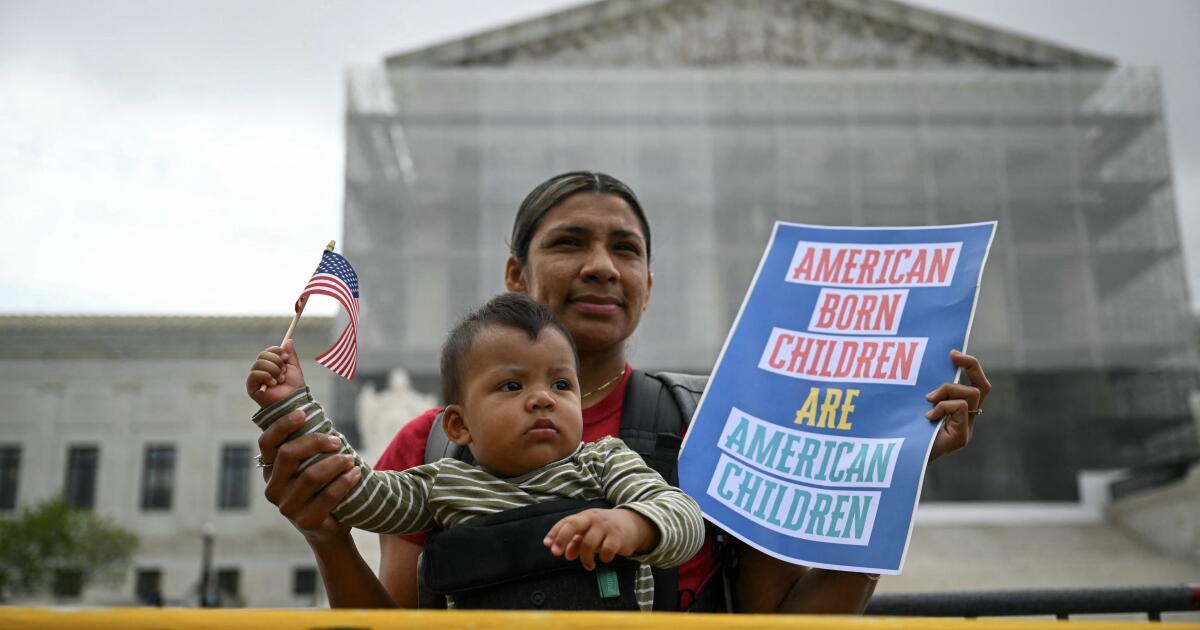
Supreme Court Questions Trump Birthright Citizenship Plan
The Supreme Court expressed skepticism during a hearing on President Trump's proposition to withdraw citizenship rights from children born to non-citizen parents, whether these parents are undocumented or in the U.S. on a temporary basis.
During the hearing, not a single justice expressed support for the restriction suggested by Trump’s administration, with several justices voicing their doubts.
Justice Elena Kagan observed, “Every court has ruled against you,” indicating a consensus against the policy.
Justice Sonia Sotomayor warned of significant consequences, noting that the policy could render countless children stateless.
The Procedural Debate
Thursday's deliberations focused on a procedural query: Does a single federal judge have the authority to halt a president's policy nationwide?
Following Trump’s issuance of the executive order seeking to limit birthright citizenship, federal judges from Maryland, Massachusetts, and Washington implemented nationwide injunctions preventing its enforcement.
Nationwide Injunctions Pose Legal Challenges
The administration claims that allowing district judges to issue such far-reaching orders undermines legal processes.
Historically, both major political parties have faced similar legal obstacles.
Arguing that the judges overstepped their bounds, while acknowledging the rarity of attempting constitutional amendments via executive order, Trump's legal team seeks judicial restraint on these sweeping rulings.
Looking for Expedited Solutions
The session on Thursday didn’t reach a clear resolution, leaving the path forward uncertain.
Justice Brett Kavanaugh suggested that plaintiffs might find more success with class-action suits for broader outcomes, though this could cause delays.
Conversely, Justice Neil Gorsuch sought a faster solution, questioning the swiftest method to address the issue fundamentally.
The Historical Context of Birthright Citizenship
Post-Civil War, the Reconstruction Congress established citizenship by birth through the 14th Amendment, guaranteeing anyone born or naturalized in the U.S. as citizens.
Early Supreme Court rulings reinforced this interpretation, confirming citizenship for the native-born children of foreign nationals since 1898.
Ongoing Debates and Legal Interpretations
Despite historical precedents, some conservative legal scholars argue that 'subject to the jurisdiction' implies an allegiance to U.S. laws over temporary or undocumented immigrants.
Trump's administration argues for allowing such restrictions to be applied on a regional basis.
Constitutional and States' Rights Implications
In a January proclamation, Trump declared a policy to resist acknowledging citizenship for children born to non-citizen or non-resident parents.
Promptly, immigrant rights groups, backed by states and major cities, initiated lawsuits arguing the unconstitutionality of Trump's directive.
Courts declared Trump’s order as non-compliant with established federal law and past court rulings, referencing the unequivocal language of the 14th Amendment.
Awaiting a Supreme Court Decision
In a March submission, the President’s legal counsel made a restrained plea to the Supreme Court, advising it to focus on controlling the spread of nationwide judicial orders rather than tackling the primary constitutional questions.
Acknowledging the rising incidence of omnipresent injunctions, the Court consented to review similar issues without detailing its rationale.
A decision is expected in Trump vs. CASA, anticipated no later than June.
Leave a Reply