


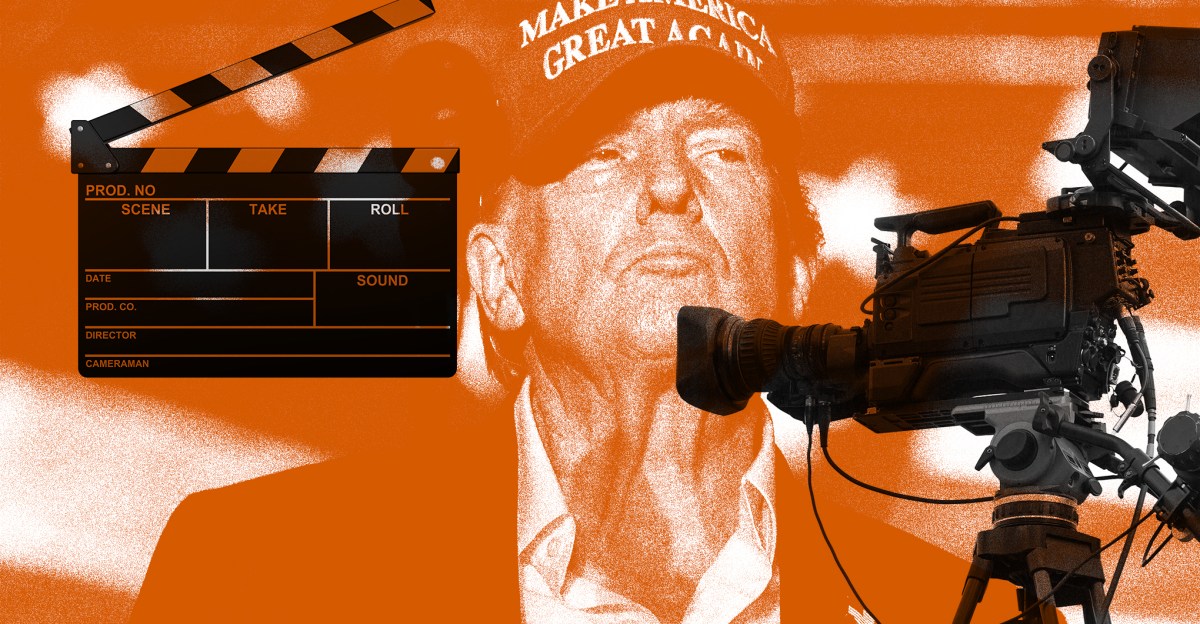
Is Trump Capable of Imposing Tariffs on Films?
Donald Trump's proposal to levy a 100% tariff on films produced abroad is still in consideration.
Having previously placed tariffs on items ranging from apparel to produce, President Trump has now turned his focus to the film industry. He has declared on Truth Social that 'the American Movie Industry is facing rapid decline,' suggesting a significant tariff on films 'made in foreign countries.'
This announcement has caused uncertainty throughout Hollywood, as it could potentially affect a wide array of films, including those with segments filmed outside the United States. Although Trump has softened his original stance by indicating to CNBC that he has no intent to damage the industry, he appears not to have completely abandoned the concept. However, similar to many of his initiatives, Trump is relying on presidential powers that are already being tested to their limits.
Mark Jones, a political science professor from Rice University, explains that placing tariffs on automobiles is straightforward because they have a tangible value at import, but applying the same principle to the complex workings of the film industry would be significantly more challenging.
The origin of Trump's tariff plan seems linked to discussions with Jon Voight, a staunch advocate of Trump, who was appointed as a 'special ambassador' to revive Hollywood. The suggested plan includes providing increased tax benefits to local producers and hints at tariffs. Voight's proposal suggests that if a film could have been entirely made in the United States but was moved to another country for production benefits, a corresponding tariff, equating to 120% of the foreign incentive, should apply.
Typically, the authority to impose tariffs resides with Congress. However, Trump has adeptly utilized emergency measures to unilaterally sanction fees on imports. His recent tariffs exploit the 1977 International Emergency Economic Powers Act (IEEPA), enabling the president to issue tariffs in reaction to any 'unusual and extraordinary' threats to the nation's security or economy.
Legal Challenges and Feasibility
Critics have noted that the current trade conditions do not justify a national emergency. According to the Brennan Center for Justice, existing trade relations cannot be branded as an unexpected crisis. If President Trump sees global tariffs as beneficial for the US, he must present his case to Congress.
The president has not clarified which legal framework he would invoke to impose tariffs on films. If it hinges on the IEEPA, it may not be applicable, given the inclusion of clauses protecting the exchange of 'informational materials,' such as media and artwork. This implies Trump might lack the mandate to tax films under his emergency prerogative.
This regulation was tested during Trump's first presidential term when legal challenges arose. In one case, a judge proclaimed that the president could not control or restrict the importation of informational materials, which do not involve a change in financial assets.
Nevertheless, another legislative option could allow tariffs on films: certain laws permit the president to modify tariffs if particular imports could 'jeopardize national security.' In his declaration about imposing tariffs on films, Trump identified foreign production as a strategy to steal films from the US, dubbing it a 'National Security Risk.'
Even if such a justification holds, the practicalities of collecting the tariffs are intricate. Films can cross into the US via numerous routes, such as cloud services, streaming platforms, or direct theater distribution, all potentially bypassing customs duties.
John Magnus, president of Tradewins LLC, a Washington, DC trade consultancy, explains, 'If attempts were made, they would differ radically from a standard tariff. The regulations the president might employ to target imported goods don't cover audiovisual content that isn't processed through customs or is already within the country.'
Toward Alternative Solutions
One possibility could be levying an excise tax, akin to those on domestic purchases like tobacco and gasoline. However, this would likely fall outside Trump's immediate control since typically, only Congress has the authority to implement such taxes. Moreover, unlike tariffs, excise taxes do not benefit from emergency powers.
Should policymakers endorse an excise tax on foreign films, the impact would extend to consumers through higher costs, affecting everything from cinema tickets to streaming subscriptions.
Economics professor Christopher Meissner from the University of California Davis observes, 'Media prices are already elevated and such moves could further limit the diversity of accessible content.'
As with several of Trump's declarations, the intricate specifics of film tariffs remain undefined, and the plan could dissolve without action. 'Frequently, much debate and scrutiny over potential policies culminate in nothing, as they are ideas Trump has no genuine intent to pursue,' says Jones. 'While the prospect remains, history suggests actual progress won't materialize.'
Leave a Reply