


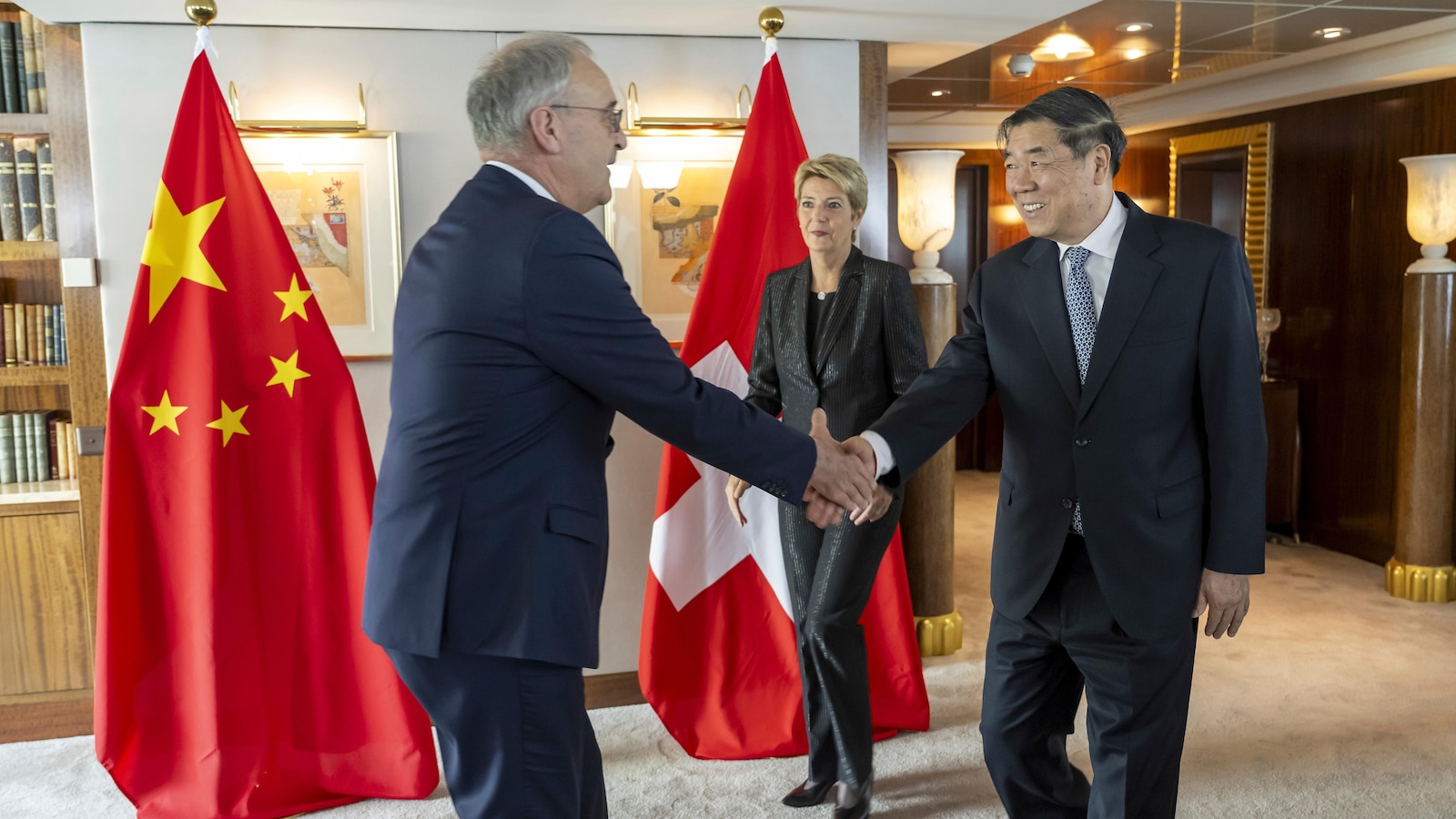
US-China Trade Negotiations in Geneva
This weekend, key US officials are set to engage with senior Chinese representatives in Switzerland to address the escalating tariff conflict that endangers trade between the globe's two largest economies.
Scott Bessent, the US Treasury Secretary, alongside Jamieson Greer, America's leading trade envoy, are scheduled to converse in Geneva with China's team, spearheaded by Vice Premier He Lifeng.
Hopes are modest for any significant progress. Nonetheless, there is anticipation that the two superpowers might ease the hefty tariffs they've imposed, thus providing relief to global markets and businesses across the Pacific reliant on trade.
Last month, President Donald Trump increased tariffs on Chinese imports, to which Beijing responded by imposing a 125% duty on US products, effectively halting a trade exchange that amounted to over $660 billion last year.
Prior to the discussions, Trump suggested a possible reduction of US tariffs on China, hinting at this on the Truth Social platform.
Sun Yun from the Stimson Center highlighted the first-time dialogue between He and Bessent, predicting limited outcomes from Geneva discussions.
“A promising outcome would be mutual de-escalation of tariffs,” she stated, proposing that even minor adjustments would convey a constructive message. “Actions, not just dialogue, are imperative.”
Since taking office, Trump has aggressively utilized tariffs as a tool in trade battles. His most contentious skirmish is with China, featuring heightened tariffs to pressure Beijing on issues like the synthetic opioid fentanyl problem.
In Trump's previous term, the US accused China of unfair practices enhancing its position in high-tech domains. Allegations included forced technology transfers and illicit acquisition of sensitive tech.
Despite a 'Phase One' agreement in 2020, which halted additional US tariffs and increased Chinese purchases of American goods, unresolved issues persist, exacerbated by the pandemic's disruption.
Resurfacing now is contention over China's technology strategies and America's vast trade deficit with China, reported at $263 billion last year.
Meeting with Swiss Officials
In addition to the Chinese negotiations, Bessent and Greer aim to have talks with Swiss President Karin Keller-Sutter.
Recently, Trump had paused plans for significant tariffs on Swiss shipments, which had been set to rise above those on EU goods. For the moment, taxes have been cut to 10%, with potential increases.
Bern's government adopts a cautious stance, acknowledging the potential repercussions for vital sectors like watch-making and chocolate production, cautioning against countermeasures due to economic costs.
Currently, Swiss exports to the US encounter a 10% surcharge, soon increasing by another 21%.
The US, following the EU, holds the position of Switzerland's second-largest trade ally, with trade dramatically expanding over two decades. Since the start of last year, Switzerland has scrapped nearly all industrial tariffs.
Leave a Reply