


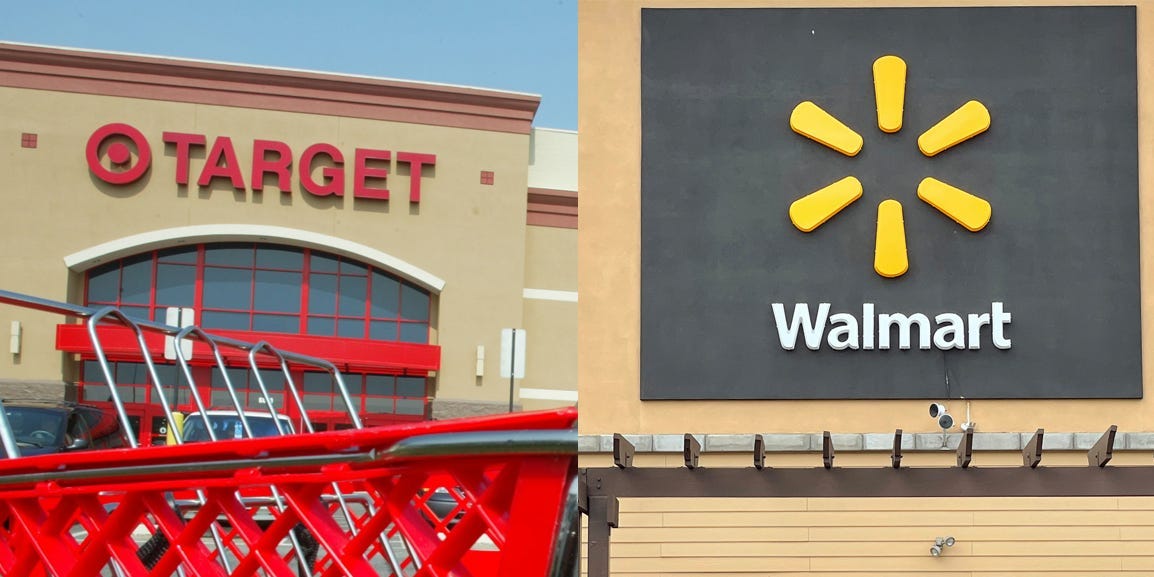
Understanding Target's Greater Vulnerability to Proposed Trade Shifts Compared to Walmart
Walmart and Target, though similar in many ways, have key differences that may lead to varying impacts from potential increases in import costs should Donald Trump implement proposed tariffs.
Target is potentially more susceptible to the effects of these tariffs than Walmart. Jason Miller, a supply chain expert from Michigan State University, explained to Business Insider that this is largely because Walmart dominates the grocery sector with predominantly domestic products.
In particular, Walmart USA collects nearly 60% of its revenue from groceries, with general merchandise contributing about one-fourth.
Recent trends show that the grocery segment of Walmart's sales is growing, while the general merchandise segment is on the decline, as described in the company’s annual report.
Conversely, Target depends more significantly on items often imported, like clothing, home goods, and cosmetics. Last year, food and drink sales at Target comprised less than a quarter of its total sales.
Retail analyst Oliver Chen from TD Cowen highlighted another challenge for Target, noting that its apparel division is particularly vulnerable because fashion trends fluctuate with the seasons. This cyclical nature can complicate the timing of orders and the sourcing of new suppliers if tariffs come into play.
According to Chen, “Missing the right season for fashion can be detrimental, given Target's heavy investment in apparel.”
Walmart's additional strength lies in its scale and size advantage over Target.
As mentioned by Gina Logan, an analyst from Kantar, Walmart isn’t just larger in terms of sales.
Logan added, “They have a more sophisticated supply network, a broader range of providers, an enhanced ability to anticipate demand, and leverage advanced automation and prediction technologies to adapt more swiftly than Target.”
The competition between Walmart's corporate symbol 'Spark' and Target's 'Bullseye' isn’t new, particularly in the grocery market.
In 2023, as American consumers tightened their spending foresight on staple goods like groceries, Walmart continued to perform robustly, while Target initially faced difficulties.
Adapting its strategy, Target began to emulate Walmart by adopting price reductions and promoting value-focused brands, gradually capturing a larger portion of the grocery market—growing by 1 to 2 percentage points annually over the last three years.
Logan predicts that if the Trump administration's tariffs are enacted, Target might pivot even further towards grocery offerings, leveraging its range of store-brand food items.
Both Target and Walmart are set to announce their financial results next week. While Walmart refrained from commenting on this topic citing its regulatory quiet period, Target did not reply to Business Insider’s inquiries.
The last public commentary from the company's leaders about tariffs was in 2019, based on AlphaSense’s data.
During that period, Walmart confirmed that food prices wouldn’t see an increase due to tariffs, opting instead to absorb costs elsewhere.
Brian Cornell, CEO of Target, emphasized concerns over tariffs in May 2019, remarking, “They could lead to increased costs on standard products for American households.”
Later, in a November discussion, he noted that Trump's tariffs were generating an additional $50 million to $60 million in expenses per quarter, stating, “Naturally, we're all navigating these tariff challenges together.”
Nevertheless, analyzing the financial data of Target and Walmart reveals that the impact of tariff hikes may not hit both retailers equally hard.
Leave a Reply