


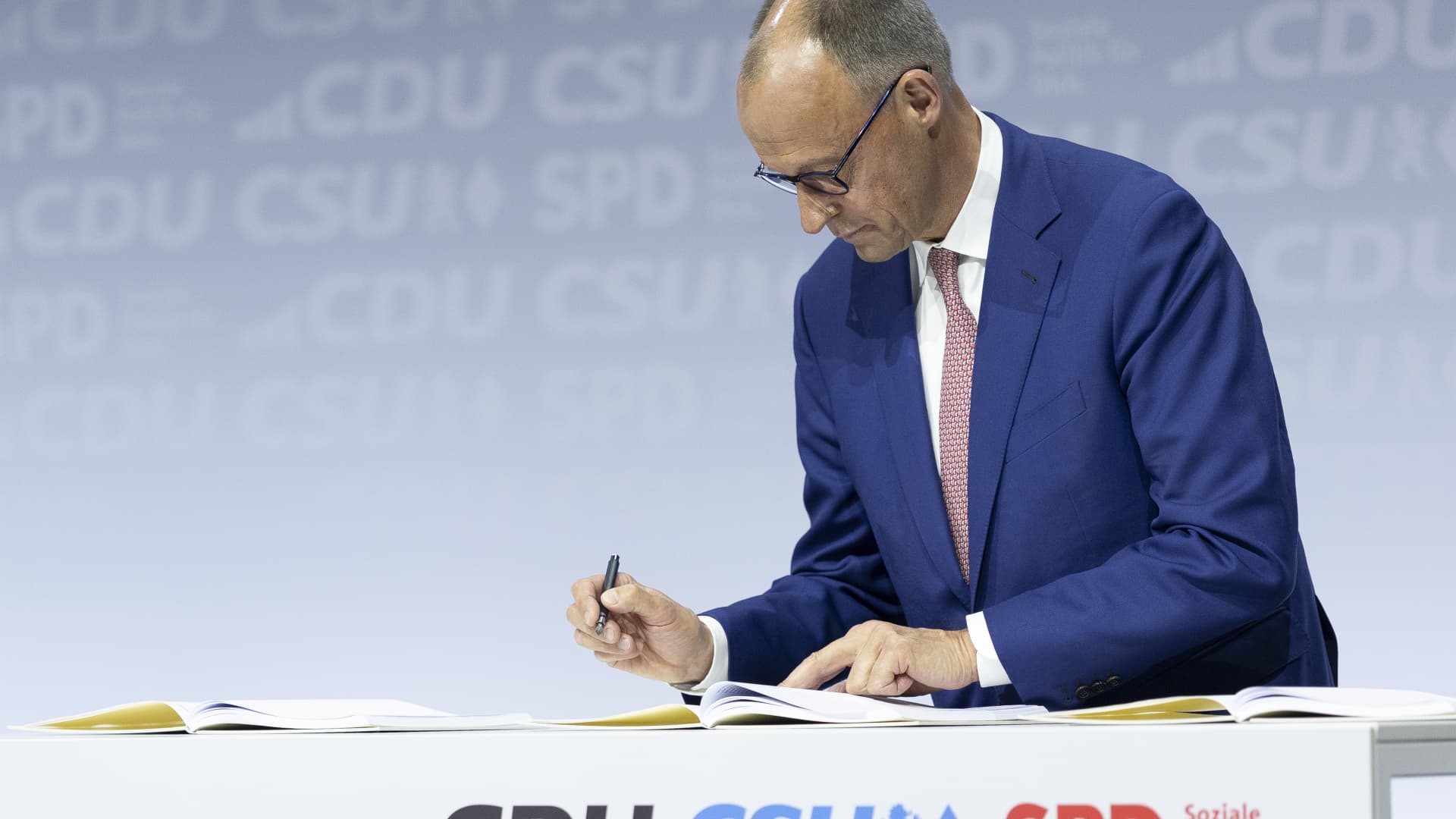
Friedrich Merz Committed to Reform and Investment as Coalition is Sealed
On the brink of a new era in German politics, Friedrich Merz, poised to become Germany's Chancellor, committed on Monday to initiating reforms and launching new investments. This announcement came as centrist political factions finalized a coalition agreement and revealed additional cabinet appointments.
Addressing the public on Monday, Merz emphasized, "You'll see a government poised to propel Germany with reforms and strategic investments," as reported by CNBC's translation.
Coalition Building
Merz, affiliated with the center-right Christian Democratic Union (CDU), along with the Christian Social Union (CSU), gained the highest votes in the recent elections. The center-left Social Democratic Party (SPD), despite coming in third, is a vital part of this new governing alliance.
Following intensive discussions, party leaders unveiled their coalition plans in early April, receiving final approvals within their ranks. The comprehensive 140-plus-page document titled "Responsibility for Germany" was ceremoniously signed by all on Monday.
Policy and Leadership
The new coalition’s plan delineates strategies concerning tax policy for individuals and businesses, updates to migration policies, and introduces a revamped voluntary military service framework. The alliances have already achieved a significant milestone: amending Germany's fiscal rules to expand defense expenditures, establishing a substantial €500 billion fund dedicated to infrastructure and climate initiatives.
Further, new cabinet ministers have been named, completing the imminent administration. Notable appointments include Katherina Reiche as the Minister of Economy, Johann Wadephul for Foreign Affairs, and Boris Pistorius maintaining his post as Defense Minister.
Key Players in Governance
Lars Klingbeil is set to take up the Vice-Chancellor role alongside his duties as Finance Minister. Holger Schmieding, a leading economist at Berenberg, noted in a briefing that Merz and Klingbeil, as pivotal decision-makers, are expected to drive the government’s agenda.
Schmieding stated, "The government will see significant leadership from Merz and the SPD's undeniable head, Lars Klingbeil, who will guide major initiatives. However, occasional criticisms from Bavarian CSU leader Markus Söder shouldn't be overlooked."
Political Context and Challenges
Merz and Klingbeil are cognizant of their task to ensure the government’s success in mitigating the ascent of the right-wing Alternative for Germany (AfD), which poses a potential threat in the lead-up to the next elections.
AfD managed to secure the second-highest vote share in recent elections, emphasizing the pressing challenge for the new coalition.
Transition of Power
Monday also marks the end of Chancellor Olaf Scholz’s tenure, as he prepares to step down. On Tuesday, anticipated parliamentary votes are expected to officially appoint Merz as Chancellor, pending formal confirmation by President Frank-Walter Steinmeier, followed by the swearing-in of the new cabinet.
The elections, originally slated for 2025, were pre-emptively held due to fractures within the preceding coalition over fiscal policies, leading to Scholz dismissing former finance minister Christian Lindner and consequently resulting in the Free Democratic Party's withdrawal from the coalition.
Leave a Reply