


The Entertaining Fictions of Star Wars Physics
Star Wars has captivated fans for years, myself included since the original film premiered during my childhood. Lightsabers and epic battles fueled my fascination with science, even though it diverges from actual scientific principles. There's always room for a lively debate: Is Star Wars truly 'science fiction' or should it be seen as 'space fantasy'?
Regardless of the genre label, elements of science appear throughout the series. Anytime there's interstellar activity, discussions about scientific principles arise. In celebration of Star Wars Day, May the 4th, let's explore some scientific inaccuracies from the saga—not to nitpick, but to explore how these elements contribute to the fun, unrealistic charm of Star Wars.
The Illusion of Sound in Space
Consider the unforgettable opening sequence where a gigantic Star Destroyer chases a smaller rebel craft, accentuated by the roar of engines. It's impactful, yet a fabrication. Space is a vacuum, devoid of air or sufficient particles to carry sound waves.
Sound originates from pressure waves; without a medium, such as air, to facilitate these waves, they can't exist. While some particles float in space, their density is negligible, rendering true transmission impossible. Yet in cinema, sound enhances the experience. The imposing engine noise aligns with our earthly experiences with maritime vessels, making the scene more relatable.
Navigating Star Wars Spaceships
In physics, forces enable changes in motion. Newton’s second law explains that in the absence of resistance, like air drag, a constant force accelerates an object indefinitely. So, running starship engines implies continuous acceleration unless they're switched off, contradicting scenes of constant velocity between destinations.
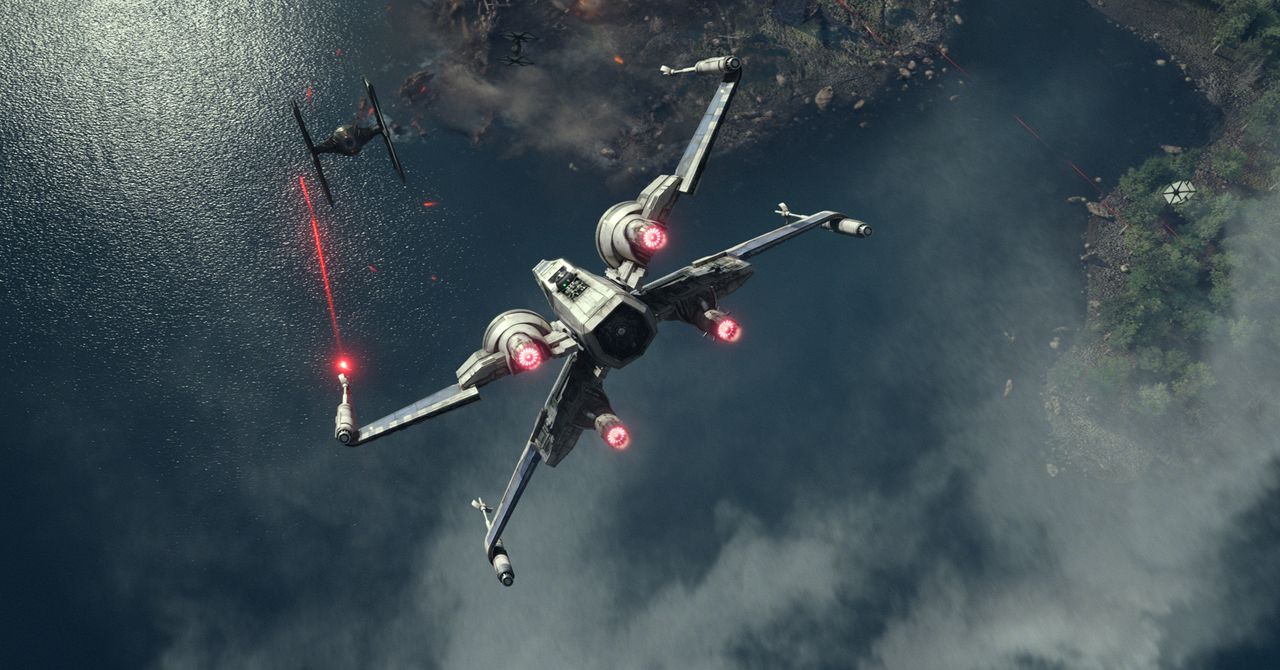
Turning starships presents another enigma. Changing direction equates to acceleration, requiring a perpendicular force. Yet, Star Wars spacecraft employ banking maneuvers seen in aircraft, relying on atmospheric lift—irrelevantly absent in space. Despite the inaccuracies, these scenes imitate thrilling dogfights, contributing to the saga's excitement.
The Visibility Illusion of Laser Weapons
Weapons in Star Wars resemble lasers, but actual lasers are invisible beams of light traveling at immense speeds—far too rapid for human perception. Even at reduced speeds in fiction, the lack of atmospheric reflection in the vacuum of space would render them unseen.
Depicting visible laser trails enhances cinematic storytelling, even if reality differs. Earth's air and dust play vital roles in scattering light beams, an aspect Star Wars sidesteps for drama.
Instantaneous Galactic Communication
Our technology relies on electromagnetic signals limited by light speed. Conversations between distant planets like Earth and Mars introduce delays of several minutes. Further distances, like reaching Alpha Centauri, would incur years of communication delay.
Star Wars shortens these delays, depicted by instantaneous messages across galaxies. While scientifically unfounded, it simplifies storytelling and embraces the saga's mystical elements, like the Force. Alterations in physics for narrative purposes ensure captivating narratives in this iconic franchise.
Leave a Reply