


US Marines' Strategic Missile Deployment Near Taiwan
To counter the increasing threat of Chinese expansion in the Pacific, the US Marines have strategically positioned new missile systems south of Taiwan.
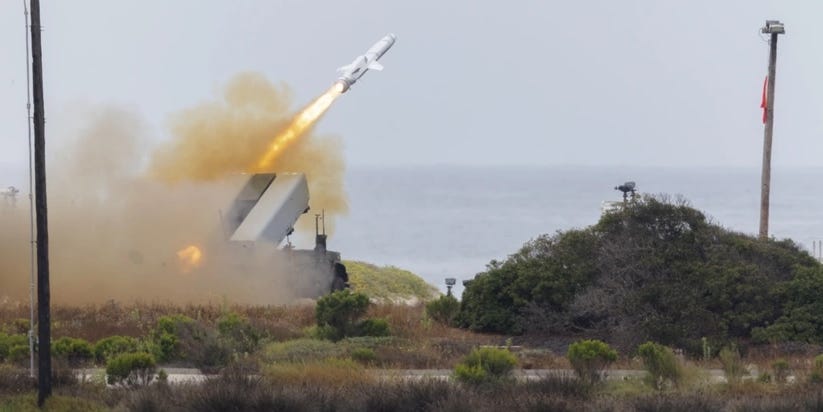
The Navy-Marine Expeditionary Ship Interdiction System, known as NMESIS, was first utilized in the Philippines during Exercise Balikatan, translating to 'shoulder-to-shoulder' in Filipino.
Over 14,000 soldiers from the US and the Philippines engaged in this exercise, which started on April 21 and will continue until May 9, alongside forces from Australia, and for the first time, Japan, making it the most extensive exercise of its kind.
The NMESIS system, crafted for the defense of the Philippines, will perform in simulated firing exercises on the Batanes Islands, strategically crucial locations close to both Taiwan and China.
Innovative Ground-Based System
The NMESIS is an advanced missile launcher mounted on an unmanned platform, designed under the Force Design initiative, which aims to modernize the Marine Corps' capabilities for maritime operations, particularly within the Indo-Pacific arena.
Each NMESIS unit is planned to feature 18 launchers, with the vision of deploying 14 units by 2030, three of which will establish a presence in the Pacific.
Specialized Naval Strike Missile
This missile system is equipped to deploy the Naval Strike Missile (NSM), a high-precision, long-range weapon capable of targeting both rugged coastal defenses and heavily fortified naval vessels.
NSMs, crafted by Norway's Kongsberg Defence Systems in collaboration with RTX, are notable for their durability and agility, extending beyond 120 miles without succumbing to electronic interference.
Throughout November, Kongsberg secured a substantial $900 million contract to provide these missiles for the Navy and Marine Corps arsenal.
Autonomous Vehicle Launcher
The NMESIS carries two preparation-ready NSMs within containers, mounted on an unmanned vehicle referred to as ROGUE-Fires (Remotely Operated Ground Unit for Expeditionary Fires), enabling operations across challenging landscapes via remote or autonomous control.
Operators have the option to manage ROGUE-Fires using a controller similar to a gaming device or orchestrate multiple systems to automatically track a lead unit.
Comprehensive Combat Trial
Spanning three weeks, the Balikatan drills emphasize anti-ship, aerial, and coastal defenses, emulating actual combat, including missile defense strategies and coordinated attacks on retired vessels.
Highlighting current security threats, the exercise's ultimate goal is to critique the regional military challenges faced today, with an emphasis on the South China Sea.
General Francisco Lorenzo clarified that, while not a direct challenge to Chinese interests, the exercises could serve as a preventive measure against Taiwan's potential conflict.
Critical Passageways Near Taiwan
During the Balikatan endeavor, NMESIS systems are transported to the Batanes Islands, pivotal regions as they lie near the Luzon Strait and Bashi Channel, connecting essential maritime routes.
Standing roughly 120 miles from Taiwan, the Batanes Islands represent a significant element in America's strategic posture against access by Chinese vessels.
The deployment of the NMESIS enables the US to regulate access points pertinent to the South China Sea and Taiwan Strait, according to military experts.
Introducing the Typhon Missile System
Recently, the US Army also stationed the Typhon missile system at the Laoag Airfield, adding another layer of defense through its ability to launch both Tomahawk cruise and long-range interceptor missiles.
With a 1,000-mile reach for Tomahawks and 300 miles for SM-6 interceptors, the Typhon system remains a fixture in the Philippines indefinitely.
Challenges to China's Defensive Strategies
In April, China voiced strong opposition against the US-Philippine military maneuvers, cautioning against the use of Taiwan-related issues to justify regional military buildups.
The Chinese foreign ministry warned others not to stir tensions across the Taiwan Strait, implying serious repercussions for all involved in such provocations.
Leave a Reply