


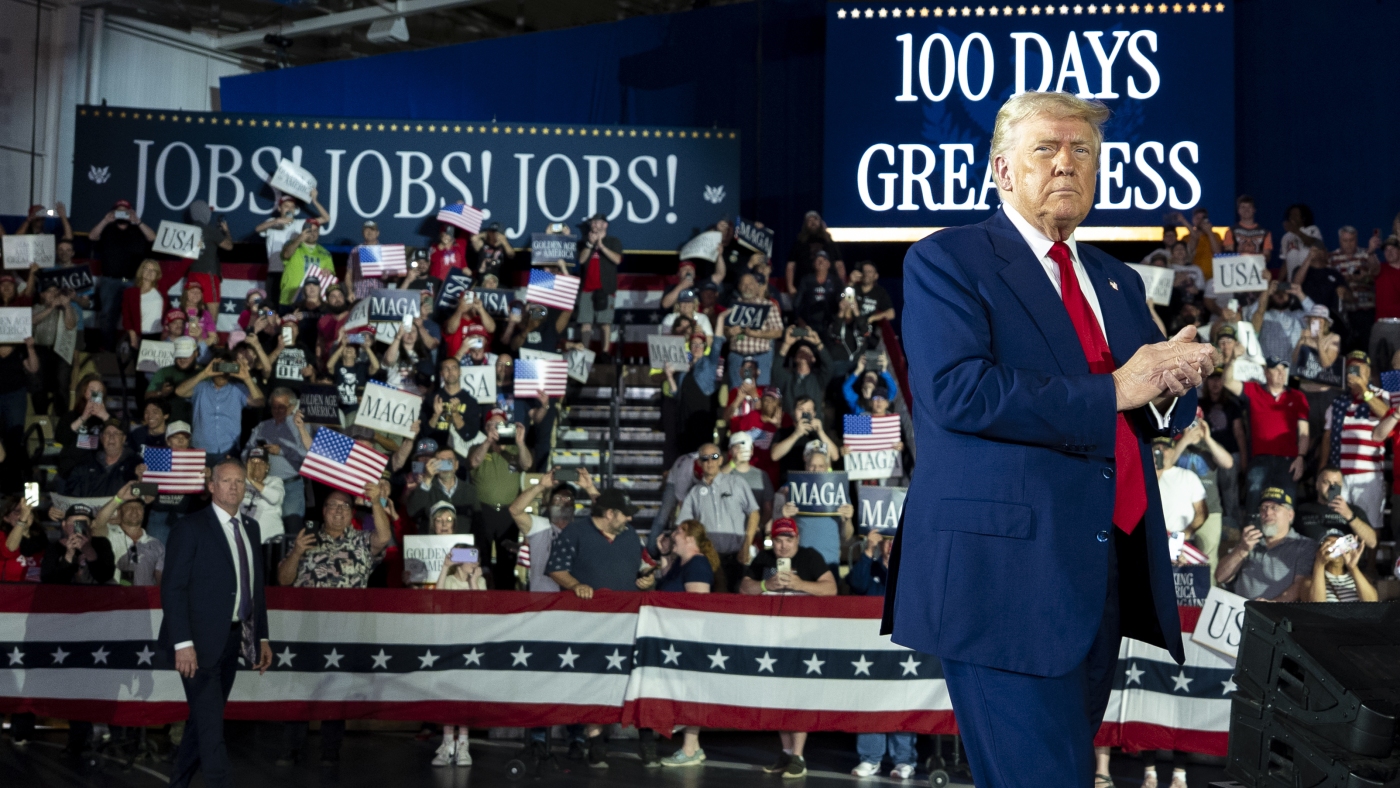
Trump's First 100 Days: Testing Boundaries and Creating Turmoil
President Trump marked his inaugural 100 days of the second term by addressing attendees at the Sports Expo Center at Macomb County Community College, Michigan.
In this short span, the Trump administration embarked on numerous significant policy shifts.
From day one, executive orders have been signed to establish DOGE, an informal entity aimed at reducing government functions, removing diversity initiatives, and repealing birthright citizenship for children born to non-permanent residents, along with stricter enforcement at the southern border.
The administration has rapidly imposed tariffs on foreign imports, revamped federal structures, and exerted control over political dynamics by deporting non-residents, recalibrating America's global stance, and punishing adversaries.
Governmental Transformation and Power Consolidation
Trump's strategy includes dismissing agency watchdogs and proponents not aligning with his views, restricting traditional media participation, and threatening them with legal actions.
Thousands of federal employees have been laid off, while financial reductions have been suggested for various programs, leading to uncertainty and anxiety among public workers.
Elon Musk, originating from the private sector, plays a pivotal role in these reforms through his close affiliation with the administration, although his efforts have sparked contention among Republicans and public dissatisfaction.
Immigration Policy and Deportations
Trump's policies targeted 'criminal' immigrants, but many law-abiding residents have also faced deportation without due process to various detainment facilities abroad, creating international human rights concerns.
Such cases have tested judicial limits and provoked debates about executive authority and foreign policy decisions.
Trade and Tariffs
At the outset of his term, Trump has focused on trade protectionism, introducing tariffs that have disrupted international relations and economic stability, causing significant political fallout.
Despite longstanding criticism of foreign trade imbalances, these efforts have met with considerable resistance both domestically and internationally.
Shifts in International Relations
In foreign policy, Trump has distanced the U.S. from its traditional democratic values and sought alliances with authoritarian figures, reframing America's global diplomatic stance.
The administration's controversial positions on global conflicts and territorial negotiations have left the U.S. at odds with international partners.
Pursuit of Retribution
Following through on campaign promises, the administration has taken stern actions against perceived electoral fraud and political adversaries, including high-profile pardons and security revocations.
This has instilled a sense of unease within political and legal circles, suppressing opposition voices.
Focus on DEI Initiatives
Trump has aggressively targeted diversity, equity, and inclusion efforts within government and education sectors, reversing many prior policy advancements.
These actions reflect a broader cultural conflict within American society regarding historical representation and minority rights.
Leave a Reply