


North Korea's Naval Power Grows with Potential Russian Assistance
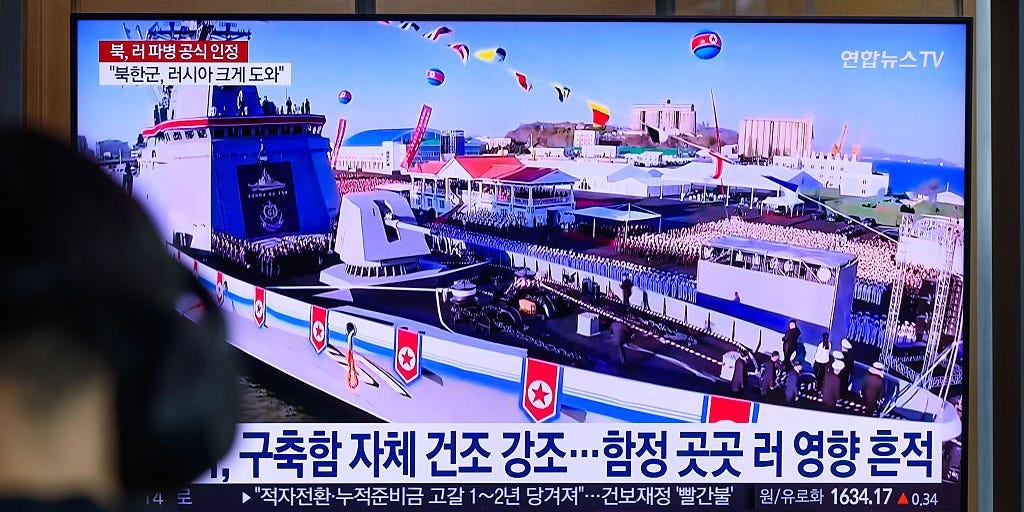
During a recent event in the port city of Nampo, North Korea introduced its latest naval creation, the Choe Hyon. Weighing in at an impressive 5,000 tons, this frigate is reportedly packed with sophisticated weaponry, which includes vertical missile launch systems.
Western observers have expressed concern over this development, as experts suggest that certain features of the vessel might have been influenced by Russian technology and design principles.
Jacob Parakilas, who leads research on defence at RAND Europe, highlighted the strategic timing of the frigate's construction as possibly signaling Russian involvement. He emphasized that the degree of Russian support goes beyond mere replication of existing designs.
Advanced Weapons Systems
The Choe Hyon is equipped with cutting-edge armaments, reportedly featuring capabilities to launch both cruise and ballistic missiles. It carries a sophisticated radar system to detect threats along with a deck gun and air defense systems.
Notably, the air defense technology onboard bears a striking resemblance to Russia’s Pantsir S-1 system, a robust asset designed to engage aerial threats with medium-range missiles. This resemblance is viewed as considerable evidence of Russian influence.
Kim Duk-ki, a former admiral from South Korea, speculated earlier this month about potential Russian technological contributions to the Choe Hyon's missile systems. He noted the impact of deploying hypersonic ballistic missiles on this frigate could significantly shift regional security dynamics.
Implications for Total Warfare
Reports suggest that Russia might be clandestinely aiding North Korea in circumventing international barriers, thus enhancing its military prowess. This support potentially extends beyond mere ship design to technological advancements, including AI-driven drones.
Parakilas noted that the frigate's array of weapons showcases a preference for heavily armed ships, aligning with Russian strategies centered on complete combat readiness. However, Joseph Bermudez Jr., a North Korean affairs expert, mentioned that there is no direct evidence of Russian construction assistance, suggesting instead that North Korean engineers may have adapted Russian designs.
Strategic Advantages and Challenges
Standing at approximately 120 meters, the Choe Hyon marks a significant leap for North Korea's naval construction capabilities, surpassing earlier ships in size dramatically. North Korea’s naval fleet, according to a strategic think tank, includes numerous smaller vessels, yet this new addition could redefine its reach.
At the unveiling, Kim Jong Un emphasized the frigate as a counter against perceived U.S. aggression, ready to be operational within a year. The warship’s capabilities suggest potential for North Korea to launch aggressive preemptive missile strikes in regions with minimal air defenses.
Experts caution, however, that as a surface ship, tracking and neutralizing the Choe Hyon remains feasible. Its full operational potential will only become evident after active deployment, as ongoing observation in its home waters will not suffice to gauge its strategic utility fully.
In summary, the Choe Hyon represents a significant evolution in North Korea's military aspirations, possibly augmented by Russian expertise. While it’s uncertain how this will alter future geopolitical interactions, its advent presents fresh challenges in maintaining regional security.
Leave a Reply