


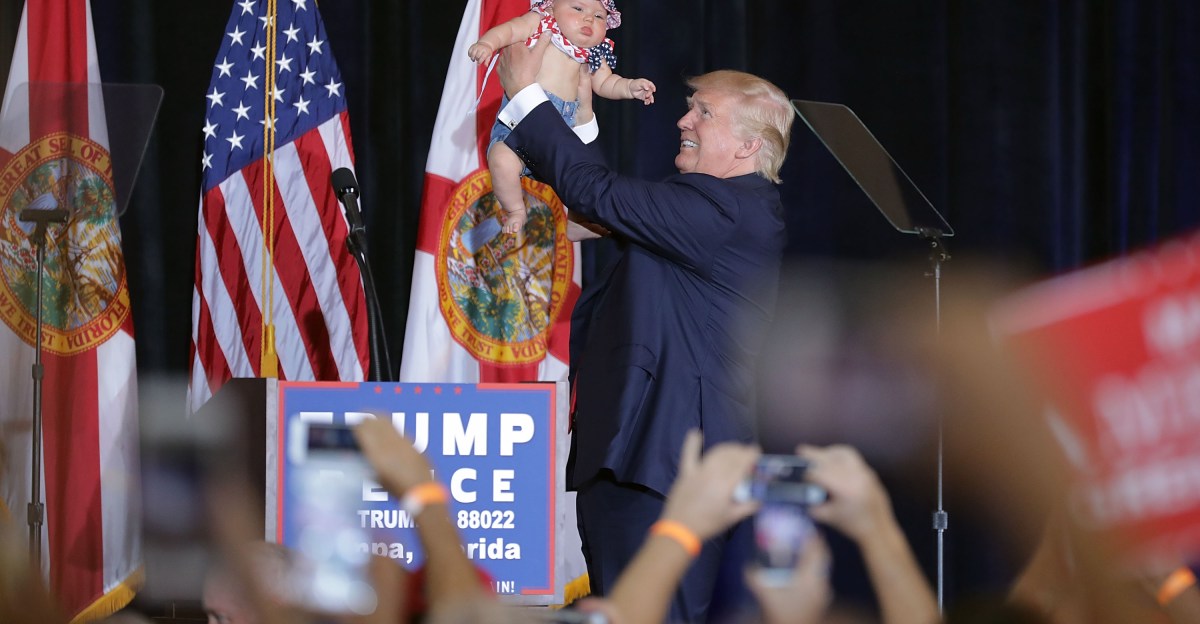
Trump's Interest in Proposals to Increase Birth Rates
The Trump administration has been on the lookout for strategies to boost marriage rates and childbearing among Americans, as noted in a recent New York Times report.
While some suggestions are seen as bizarre—for instance, reserving Fulbright scholarships for those married with children—others seem unsettling, like giving a 'National Medal of Motherhood' to women raising six or more offspring, reminiscent of policies from Nazi Germany. With Republicans determined to slash the federal budget by at least $1.5 trillion, economic ideas are facing significant obstacles. However, if Trump, who dubbed himself the 'fertilization president,' endorses these 'pronatalist' initiatives, it's likely Republicans would rally to support them.
The Concept of a Baby Bonus
One proposal Trump might find appealing is offering a one-time 'baby bonus.' The Times mentioned a suggestion for a $5,000 payment to new mothers, which Trump recently described as 'appealing.' This is not the first time he has supported such an idea; at the 2023 Conservative Political Action Conference, he advocated for 'baby bonuses' to initiate a new baby boom.
These recent pronatalist concepts have sparked intense discussions and skepticism from the left, with one progressive activist likening them to 'state-enforced coercion in a milkmaid costume.' But globally, baby bonuses are not extreme; they provide financial aid to new parents. The real question is not whether these payments could slightly elevate birth rates or offer immediate financial help, but whether their adoption would push a political narrative centered on conventional gender roles and reproductive repression, while disregarding essential societal investments for parents.
Variations of Baby Bonuses
In the US, there are multiple versions of the baby bonus concept actively being considered. Beyond the $5,000 proposal, the Niskanen Center has put forward a $2,000 baby bonus, mindful of financial constraints, while the American Compass think tank suggests $2,000 for single parents and $4,000 for married pairs, aligning with wider conservative initiatives to promote marriage.
Last year's presidential campaign saw Democratic candidate Kamala Harris introduce her version of this initiative: a $6,000 tax relief for new parents. Harris emphasized how this would lessen financial burdens on families during their child's initial year, a crucial phase of early development. However, it was unclear if her plan would be distributed as a single sum or over monthly increments.
Global Examples and Their Effects
Globally, baby bonuses are delivered in various forms—lump sums, monthly payments, or a blend of cash and essentials. Finland launched the concept in 1938 with a program offering low-income mothers a choice between cash or a 'maternity package' of necessary items. This initiative expanded to include all expectant mothers fulfilling prenatal appointment requirements by 1949, inspiring more than 60 other nations.
Australia, for example, offers new parents about $1,700 over 13 weeks, and Singapore extends its baby bonus, totaling approximately $8,000, over 6.5 years. Germany supplements its universal childcare system with child stipends of about $275 monthly, while Japan provides a $3,200 lump-sum bonus along with $100 monthly for children under three.
Implications for Fertility Rates
Simply giving families a few thousand dollars is insufficient to trigger a significant 'baby boom.' Although such policies worldwide tend to have a fertility-boosting effect, the impact is generally limited and variable. In certain scenarios, baby bonuses only serve to decelerate fertility decline rates; for example, a study highlighted that without monetary transfers, South Korea's fertility rate would have been 4.7 percent lower in 2015.
The Niskanen Center's Leah Libresco Sargeant, who proposed the $2,000 baby bonus, views the idea as not potent enough to drastically alter fertility intentions but believes it could aid some parents in opting to continue pregnancies they might terminate for monetary reasons.
Ultimately, Sargeant sees the potential for such policies to assist Americans in transitional life phases, either by providing for family assistance or enabling job-protected leave under the unpaid Family and Medical Leave Act.
Political and Economic Challenges
Progressives argue that the focus on baby bonuses diverts attention from wider, impactful issues within Trump's framework, like tariffs increasing childcare costs and potential economic downturns. Critics point to the administration's actions, such as diminishing maternal health resources, targeting preschool program funding, and leaving the lack of paid parental leave unaddressed.
There's also analysis of financial skepticism within conservative circles, noting fiscal conservatives' opposition to increased federal spending, fearing it could elevate national debt and tax burdens. They prefer expanding existing child tax credits over new refundable credits.
Amid ongoing debate over birth rates, fiscal policies, and reproductive rights, American families find themselves ensnared amidst conflicting political objectives, often leading to a lack of immediate necessary resources.
Leave a Reply