


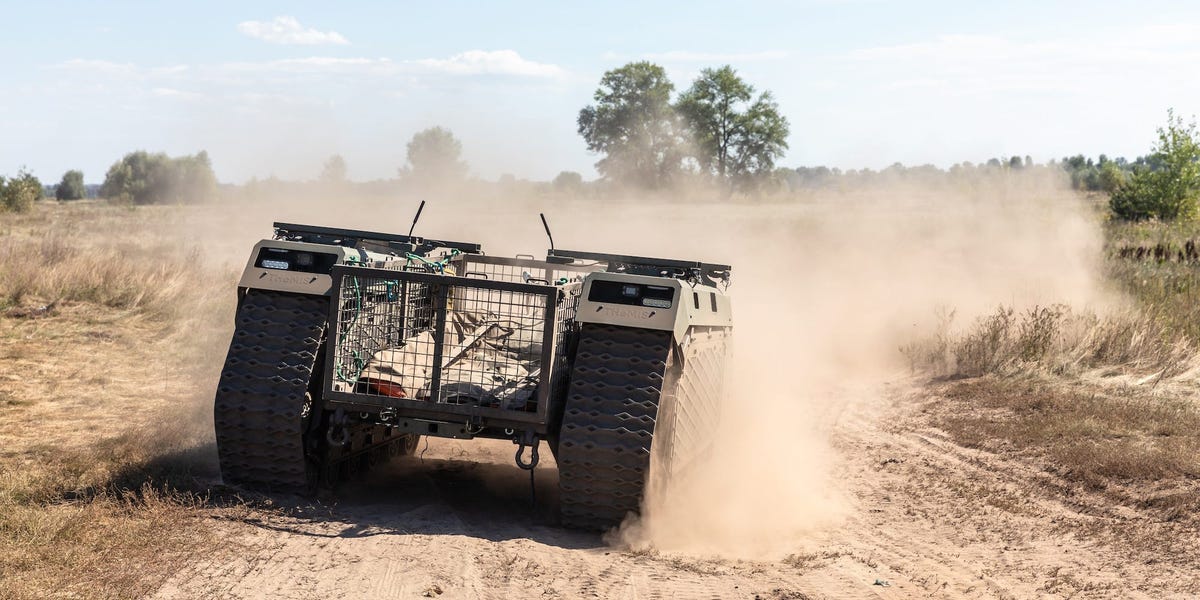
Ukrainian Forces Rely on Ground Robots for Soldier Evacuations, Despite High Risks
Ukrainian military personnel occasionally deploy ground robots to rescue their injured comrades, but due to the associated high risks, this strategy is reserved as a last option, according to a unit operator's statement to Business Insider.
The prevalence of robotic assistance on the battlefield is growing as the conflict continues, marking a technological shift.
In the realm of combat, drones are taking on roles previously fulfilled by traditional forces, with uncrewed ground vehicles (UGVs) alleviating the direct exposure of soldiers to hostile fire.
Ground-based drones, capable of evacuating wounded soldiers without endangering additional troops, present a potentially transformative advancement in a warfare environment rife with surveillance and targeted attacks on medics.
However, Oleksandr Yabchanka, who leads robotic systems for Ukraine's Da Vinci Wolves Battalion, explained that these drones can sometimes exacerbate risks for the injured, limiting their use to scenarios with no other viable options.
Only When There's No Other Way
According to Yabchanka, when evacuation teams attempt to rescue the wounded, they face significant threats from the numerous surveillance drones directing enemy fire, putting them in constant peril.
While Ukraine has invested in robotic solutions to mitigate this risk, the use of these technologies for evacuations remains infrequent, Yabchanka noted.
As the UGV technology is still evolving, his unit often tests new and improved drone models, though they are yet to reach an optimal standard, he commented.
During transport, if a drone's system fails or is disrupted by enemy jamming, a soldier can find themselves isolated, posing a serious problem for operators.
The isolation of a wounded soldier due to connectivity loss means no immediate communication or aid is available, heightening the risk.
Previously, while hazardous, the injured were at least accompanied by their fellow soldiers.
Thus, deploying human teams for evacuation remains the preferable choice, despite the inherent dangers involved.
Limited Alternatives
Yabchanka mentioned that traditionally, extracting a soldier from the front lines involves a minimum of four personnel, and the task is complex due to enemy surveillance.
Often, avoiding detection during the extraction is either highly difficult or utterly unfeasible, he noted.
There are instances where an evacuation team cannot approach the wounded without getting noticed, likely drawing hostile fire towards them and the casualty.
In circumstances where invisible evacuation is impossible, reliance shifts to ground robots. Most robotic evacuations occur when no other options exist.
The Rise of UGVs
Unmanned ground vehicles represent a relatively new addition to military technology. Unlike aerial drones, their deployment has not yet become widespread across the Ukrainian forces. However, these vehicles have facilitated evacuations along certain front lines.
UGVs might become indispensable for Ukraine's smaller-sized military, which lacks the resources to ensure immediate medical care typical of Western forces' 'golden hour.'
Beyond evacuations, Yabchanka's unit utilizes ground drones for tasks such as planting mines, relocating gear, and impacting enemy positions.
Although currently underutilized or minimally deployed by many units, various Ukrainian enterprises are advancing this technology and enhancing its application.
Notable contributors in this tech sphere include Ukraine's Rovertech, creators of the ZMIY Ground Demining Complex, and FRDM Group, makers of the D-21 ground robotic system.
As Russia also invests in this domain, the development race is anticipated to accelerate, mirroring past trends observed with aerial drones.
According to Yabchanka, advancing ground drone technologies poses not the question of 'if,' but 'when' Russia escalates efforts, underscoring the urgency to outpace them in this innovation race.
Ukraine's intelligence chief, Kyrylo Budanov, foresees a significant increase in the deployment of robotic systems, potentially expanding into the tens of thousands.
Hlib Kanevskyi, head of procurement for Ukraine's Ministry of Defense, has indicated plans to integrate 15,000 combat robots into their force this year.
Leave a Reply