


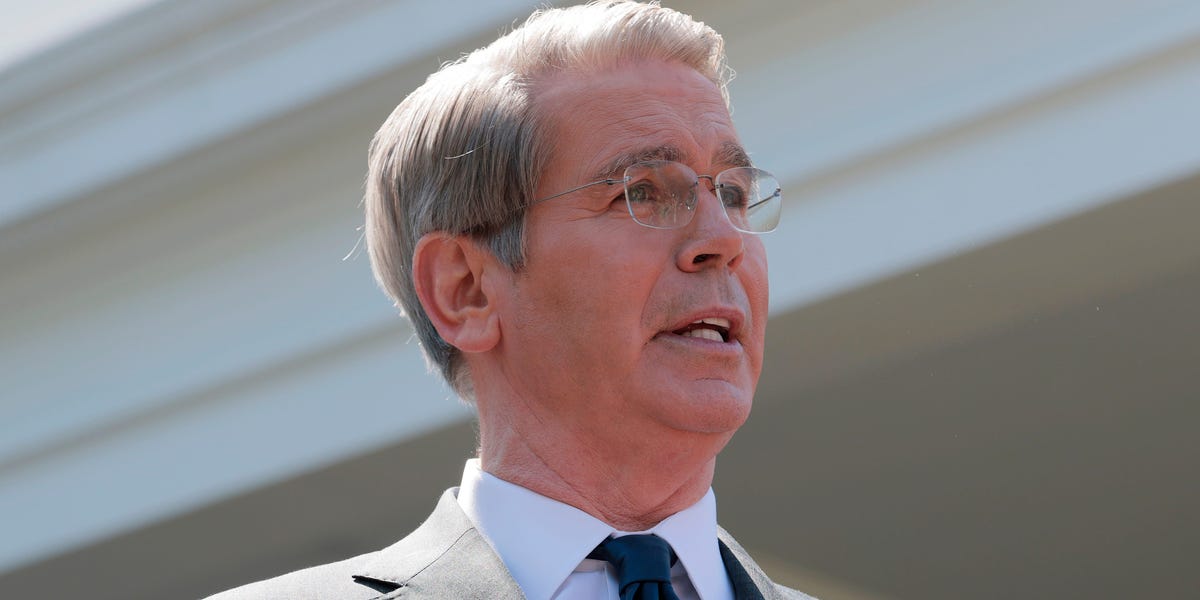
Treasury Secretary Bessent Justifies Trump's Trade Negotiation Tactics
Scott Bessent, the U.S. Treasury Secretary, argues that President Donald Trump's method of employing 'strategic ambiguity' is a calculated move in international trade discussions.
In a Sunday segment on ABC News' "This Week", co-hosted by Martha Raddatz, Bessent robustly supported Trump's tariff measures despite criticism of economic management under Trump.
Referring to principles from game theory, Bessent described the unpredictable nature of Trump's tariff maneuvers as 'strategic uncertainty.' According to him, Trump's skill at creating negotiation leverage is unmatched.
Bessent illustrated the approach by noting the use of high tariffs as a pressure tool, alongside offering concessions, such as removing tariffs or non-tariff constraints, halting currency manipulation, and ending labor or capital subsidies, as incentives for dialogue.
In early April, significant global attention was sparked when Trump unveiled substantial tariffs impacting numerous long-standing U.S. trade partners.
Nonetheless, soon after this announcement, Trump suspended the most severe tariffs for three months, instead maintaining a moderate 10% tariff for the majority.
Trump's tariff strategy aims to reduce the trade deficit and adjust tariff practices he claims unfairly disadvantage the U.S., particularly its manufacturing sector, in global trade.
This trade policy by Trump has strained U.S.'s traditional alliances, notably with Canada and Mexico, and severely damaged its relations with China. His recent actions have increased market fluctuations, drawing skepticism from economists who question the unpredictable nature of the strategy.
The confrontation with China escalated as Trump imposed a hefty 145% tariff on Chinese imports, prompting a retaliatory 125% tariff on U.S. exports by China.
Despite these tensions, Bessent conveyed optimism about finding a resolution to the trade conflict with China, suggesting there’s a feasible route to negotiation.
Bessent outlined that a first step involves reducing tensions, which he believes is necessary for China to engage in, paving the path for a trade agreement.
According to Bessent, while a formal agreement may take time, initial consensus and adherence to agreed-upon terms by trading partners could prevent tariffs from rising back to their peak levels.
Leave a Reply