


Unveiling Ukraine's Drone Revolution: An Economic Approach to Modern Warfare
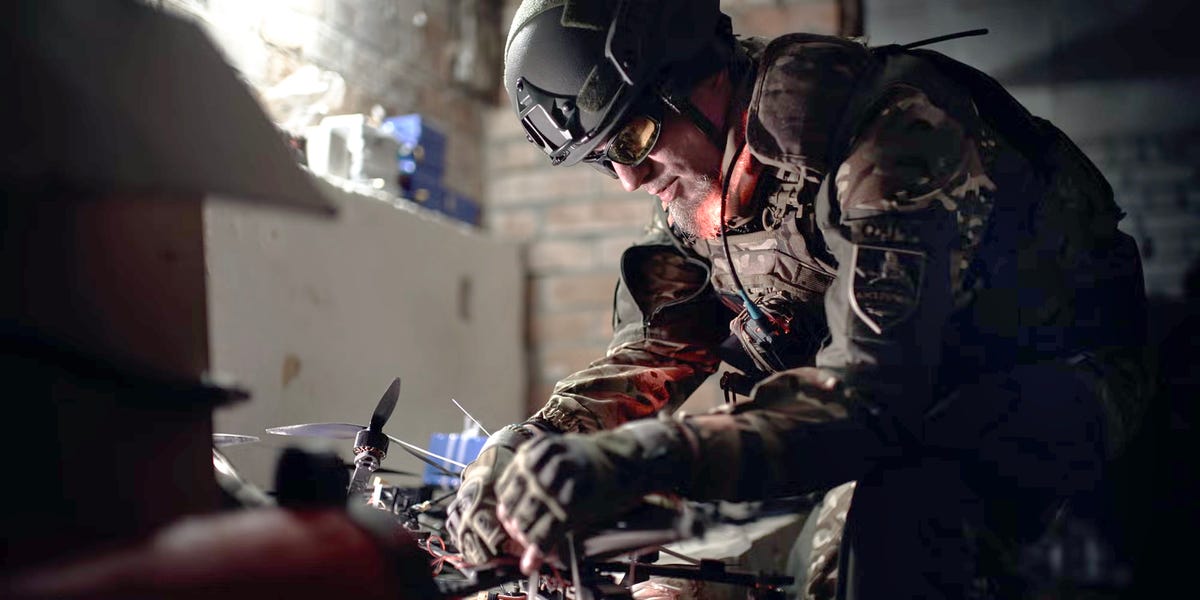
Within an unassuming building in Kyiv, drone components are stacked on metal shelves, nestled in cardboard boxes, and scattered on floors. Young employees are diligently transforming black, rectangular frames into formidable weapons.
Nearby, rooms house numerous small quadcopters, resembling oversized toys. These soon-to-be combat tools will assist Ukraine's fight against Russian advances employing unconventional warfare techniques.
This production line, a part of 3DTech, exemplifies the thriving drone manufacturing landscape in Ukraine, where vast numbers of drones are built using inexpensive materials such as motors and carbon-fiber frames, primarily sourced from China. This cost-effective approach enables the assembly of a significant arsenal at a fraction of typical costs. This progress positions Ukraine as a competitive force against Russia's military power, producing a reported 2.2 million drones recently, surpassing Moscow's output.
Globally, Ukraine's innovative approach in drone warfare serves as a masterclass. Business Insider's recent expedition to Kyiv involved discussions with drone industry leaders, revealing insights valuable to nations worldwide.
Innovative Manufacturing Under Constraints
Ukraine's demand for thousands of combat-ready drones each month drives a focus on swift assembly and economical part sourcing. Notably, drone production activities are emerging in unexpected locales such as residential apartments and basements, reflecting the unprecedented growth and adaptability within this industry.
Maintaining cutting-edge technology necessitates intensive collaboration between manufacturers and military personnel actively engaged in combat. Ukrainian soldiers frequently communicate with drone producers to facilitate rapid enhancements, ultimately yielding superior battlefield equipment.
A Self-sustained Industrial Force
Ukraine's drone production goal is ambitious: doubling output to reach 4.5 million aircraft in the near future. This undertaking receives substantial support from the defense ministry, alongside contributions from international allies, charitable donations, crowdfunding, and even direct military unit investments.
Rustem Umerov, Ukraine's defense minister, has expressed confidence in the country's position as a leading drone producer globally, emphasizing innovation across tactical and strategic levels.
A Strategic Evolution in Warfare
In response to the 2014 invasion by Russia, Ukraine significantly increased military spending, progressing from a modest $62 million budget to $836 million by 2021, according to SIPRI.
The full-scale war initiated by Russia in 2022, with its attempt to overtake Kyiv, led to a dramatic rise in defense allocations—reaching nearly $31 billion by 2023.
Oleksandr Kamyshin, formerly Ukraine's minister of strategic industries, articulated the nation's transformation from a peaceful agricultural center to a burgeoning defense hub, spurred by necessity and resilience.
Pioneering Asymmetrical Combat Solutions
Facing material and manpower disadvantages vis-à-vis Russia, Ukraine's strategy evolved to include cost-effective alternatives, particularly drones. In the conflict's initial phases, Ukraine encountered challenges related to artillery shortages and expensive missile procurement.
Ukrainian companies have since diversified into producing various drone types, from small FPV (first-person view) models to medium- and long-range drones capable of penetrating deep into enemy territory, targeting military and energy structures.
Furthermore, Ukraine's military utilizes several naval drones in operations against Russian maritime assets and deploys ground robots for operational and logistical purposes.
Financial Innovations and Market Dynamics
The genesis of Ukraine's drone industry was marked by civilian ingenuity and innovative start-ups, often initiated by individuals with backgrounds in software and engineering outside the traditional military sphere.
Governmental recognition of these projects spurred further development, bolstered by initiatives like United24’s Army of Drones and Brave 1, launched to fast-track promising technologies to the frontlines.
Adapting to Changing Warfare Landscapes
The industry has notably expanded to address electronic warfare challenges, which both Ukrainian and Russian forces encounter. Approximately 150 companies now innovate solutions, including fiber-optic drone technology, which withstands electronic disruption through stable, unjammable cables.
Rebel Group, a Kyiv-based company, exemplifies this advancement by focusing on defensive measures against these advanced technologies.
Emulating Ukraine's Success
Ukraine's approach contrasts significantly with that of its NATO counterparts, like the US, which often prioritize complex, high-cost military systems over quick, high-volume production of more economical solutions.
Kateryna Mykhalko of Tech Force highlights Ukraine’s ability to promptly innovate and adapt, expediting development from concept to combat validation. This flexible model ensures alignment with immediate battlefield demands and paves the way for scalable investments.
While NATO allies observe Ukraine's advancements with growing interest, the country's restrictions on exporting military technologies present challenges to capitalizing on international opportunities.
Despite limitations in resources and scale when compared to Russia, Ukraine’s rapidly evolving defense industry, characterized by innovation and quality, represents a crucial element of its strategy to resist and overcome adversity.
Leave a Reply