


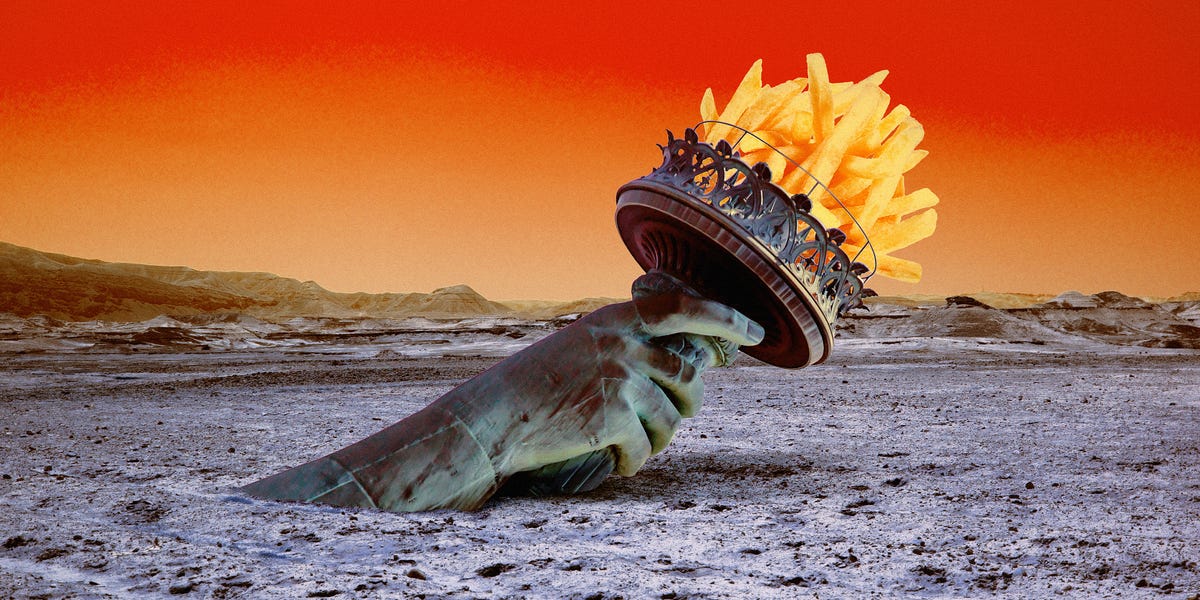
Trump's Tariff Threat: Could Fries Become a Rare Treat?
French fries, a beloved reward and comfort food in the US, might soon be seen more as a premium delight.
The United States, while producing a large portion of its own potatoes—amounting to around 44 billion pounds annually—doesn't domestically source most of its cooking oil. For the perfect crispy fries, canola or soybean oil is often preferred by culinary experts in America. A significant portion of canola oil is imported from Canada, which faces risk from the tariffs imposed by President Donald Trump.
These extensive tariffs—a minimum of 10% targeting nearly every nation from China to Sri Lanka—are causing concern for businesses and consumers alike. Economists caution that prices will rise on various products, from vehicles and apparel to electronics and even vanilla. With substantial trade crossing the Canadian border, the tariffs on Canadian goods stir particular worry, impacting about $762 billion in annual trade. While there's already a 25% tariff on Canadian goods that aren’t under the US-Mexico-Canada Agreement, this now extends to goods like steel, aluminum, and automobiles. Recent tariff hikes on compliant goods were postponed, leaving uncertainty in their wake. One item, tied closely to American culture and once renamed by some as
A superior french fry is subjected to two frying phases: initially blanched until soft and creamy inside, and next, fried at a higher temperature to achieve a crispy exterior. These fries are a favorite among restaurant owners due to their quick preparation and profitability compared to meat and other vegetables. According to the US Canola Association, the US imports 69% of its canola oil—with a staggering 96% sourced from Canada. Additionally, around $1.7 billion worth of frozen fries, similar to those served in most fast-food outlets, come from Canada. Over the past few years, more frozen fries have been imported than locally produced, all duty-free, courtesy of trade agreements like USMCA and NAFTA.
The Impact on Restaurants
Codi Bates, who directs The Burger Stand in Lawrence, Kansas, comments on fries being perceived more luxuriously due to increasing delivery costs. Her establishment spends around $32,760 yearly on importing canola oil. Managing 630 pounds of cooking oil weekly for assorted fried foods already squeezes her profit margins thin. Should tariffs affect USMCA-compliant imports, her business strategy may need a serious rethink.
Many other eateries are anxiously facing a potential financial strain.
French fries remain a sought-after choice for consumers in America. In 2023, it was estimated that in millions of restaurant visits, diners chose fries 14% of the time according to research by Circana, formerly known as NPD Group.
Historical Shifts in Fry Cooking
Historically, fast-food chains including McDonald's, Arby's, Burger King, and Wendy's thrived on flavor-rich tallow for fry cooking. However, health risks tied to fats, driven by marketing from the sugar industry, led to canola oil—a lower-acid variety derived from rapeseed—becoming the norm. Canada's innovation in canola following WWII explored its potential beyond industrial use, thus securing its place in kitchens worldwide. Throughout the 1990s, fast-food brands switched to this long-lasting alternative.
Economic Burdens Looming
French fries are not only delicious but vital to restaurant profitability, often costing less to provide than the same menu’s burgers in terms of percentage. Even prior to Trump's tariff activities, economic challenges existed—food costs increased, reflecting in eating habits. In October, Lamb Weston, a key supplier, closed a factory in Washington, reducing output by 5%.
Despite a decline in fry popularity, these beloved side dishes continue to help eateries offset ascending costs for other essentials, such as beef, which surged by 40%, and eggs nearly doubling in price over five years. The cooking oil market, having climbed by roughly 50% from 2020, poses yet another threat to fries as an affordable side option.
Professor Henry An from the University of Alberta cautions that these increased canola costs will impact all chain participants—from suppliers to diners. He points out that the Canadian canola market lacks short-term buyer options, and rigid planting schedules add to the sector's challenges amid ongoing tariffs.
Effective Adjustment Strategies
Varied strategies may help mitigate rising costs. Importers might choose to shoulder some expenses rather than elevate restaurant charges. Restaurants might likewise either absorb or maneuver costs by adjusting their supply chain to stabilize fry pricing for patrons. Yet costs inevitably creep along: during five years of inflation, McDonald’s fries escalated by 134%, while labor and operational expenses also contributed.
Culinary establishments can either endure reduced profits, adjust fryer ingredients or potentially return to tallow recently embraced amid criticisms of seed oils. Options remain sparse; a 35-pound canister of animal fat multiple times outweighs canola’s cost, with some diners shelling out $8 for size upgrades of duck-fat fried delicacies.
Valuing Fry Sustainability
Rather than abandon canola, some eateries aim for economy in its application. Fryers monitor oil quality carefully, preventing excess usage by swapping before it emits smoke or tastes poorly. Installing dual-tank systems, like at Tuk Tuk Snack Shop, optimizes oil lifecycle by extracting used oil, subsequently repurposing it as biofuel.
Chef Samantha Fore, who spends $15,000 annually on a soybean oil blend, worries that tariff consequences on imports could inflate domestic oil costs significantly.
"The uncertainty of where these changes could lead is daunting," admits Fore. "A significant price hike on fries might drive them from everyday meals to occasional pleasures."
Catherine Mendelsohn of Sunnyside Restaurant Group reassures her clientele that robust oil management tools will relieve tariff-induced costs.
Christian Plotczyk from Knead Hospitality + Design affirms that existing contracts shield them from price fluctuations until 2025. Afterward, adaptions like oil substitution may be required, if tariffs persist.
Adapting to the Frying Future
For fry enthusiasts like Demetri Tsolakis from Xenia Greek Hospitality, exploring pricier yet efficient alternatives like sugarcane oil, which slashes kitchen changes by extending fryer use, holds potential albeit at higher investments.
Yet, the demand for substitute oils could spark supply concerns akin to the beef tallow shortage within the US, emphasizing the economic weight Trump’s trade strategies may impose on culinary traditions like fries. Experts remain cautiously unsure about this ever-evolving situation, as existing margins face scrutiny under changing trade relations.
Leave a Reply