


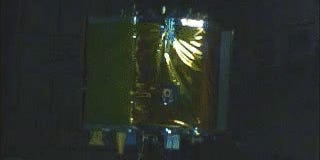
Space Warning Alerts Surpass a Thousand Daily as Orbital Traffic Surges
The clutter in Earth's orbit has reached such alarming levels that managing collision risks has turned into a full-time responsibility.
Physicist Thomas Berger highlighted during a session at the American Geophysical Union in Washington DC, that remnants like non-functional satellites, rocket remnants, and even stray items like tools have been abandoned in orbit.
Beyond these identifiable remnants, millions of smaller fragments zip around at speeds exceeding that of a bullet, escalating the threat of catastrophic collisions that jeopardize astronauts and operable satellites.
Growing Threat from Orbital Debris
Berger noted that the density of orbital debris is now so substantial that an average of 1,000 collision possibility alerts are issued to satellite controllers daily.
Araz Feyzi, leading Kayhan Space, mentioned some satellites in their service register as many as 800 notices daily from U.S. Space Force warnings.
Co-founder Siamak Hesar, in a SpaceNews article, shared how their company processes upwards of 60,000 alerts weekly for an array of satellites numbering around 100.
A significant concentration of these alerts is centered near the 550-kilometer mark, a zone also occupied by SpaceX's Starlink satellites.
Berger, now with the University of Colorado's Space Weather Tech Center, stated that operators struggle to discern which alerts are critical and require action.
The Imminent Risk of Chain Reactions
Because predicting exact positions of space debris is imprecise, alarms are typically raised when elements are likely to get precariously close, though only a fraction result in actual impacts.
Collisions can shatter space objects into fast-moving fragments that further increase the hazard, potentially setting off a cascade of collisions in what's known as the Kessler syndrome.
Notable Incidents and Mitigation Pressures
Although uncommon, major crashes have punctuated history. A 2009 collision between U.S. and Russian satellites resulted in nearly 2,000 trackable fragments of significant size, with many smaller pieces.
A more recent 2021 incident saw a collision involving a Chinese satellite and a discarded Russian rocket, adding at least 37 detectable fragments into orbit.
Destructive tests of anti-satellite weaponry by Russia, China, and India have compounded the debris problem by shattering defunct spacecraft, launching thousands more fragments into unpredictable trajectories.
Habitual near misses have prompted measures such as the International Space Station preparing for potential emergency maneuvers when alerted to approaching debris.
Response Measures and Legislative Push
While some satellites are capable of avoiding collisions through preemptive positioning, not all are maneuverable. In a recent scare, NASA was able to only watch as a defunct Russian spacecraft narrowly missed one of their non-maneuverable satellites by a mere 17 meters.
Daniel Baker, leading UC Boulder’s space science lab, emphasized the urgency for U.S. Congress to endorse the ORBITS Act, aiming to galvanize government bodies in backing technologies to eliminate space refuse.
Baker highlighted the unfolding 'tragedy of the commons' in Earth's lower orbit, warning of the potential for key space regions becoming unusable without intervention.
Leave a Reply