


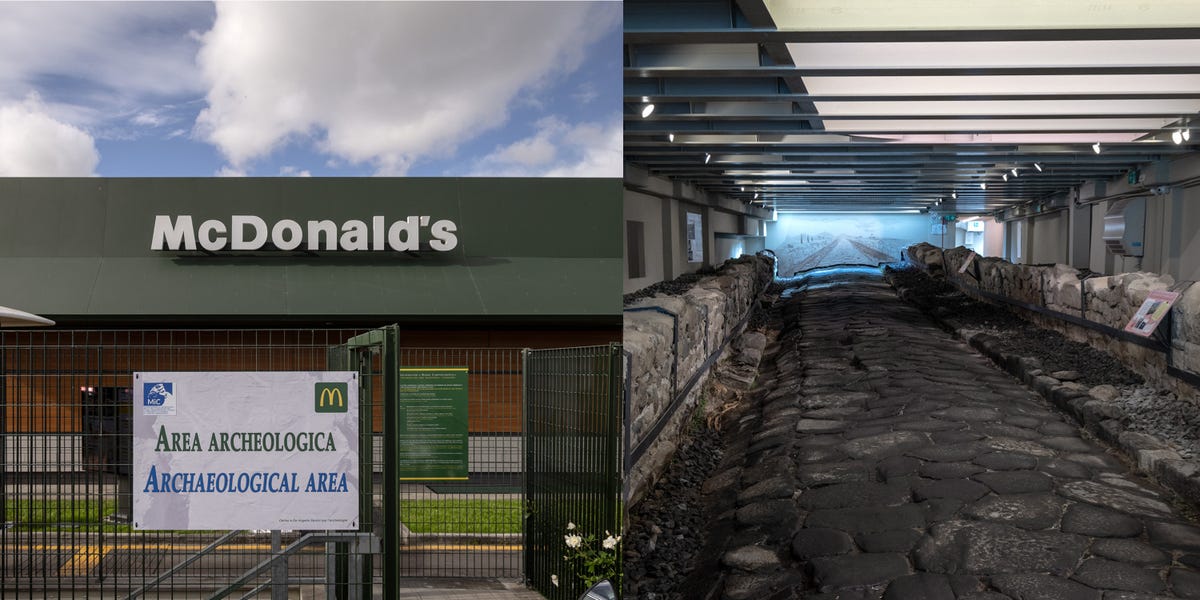
Discover Ancient Ruins at This Italian McDonald's
From the exterior, it appears to be a regular fast food outlet, but as you venture inside across its glass flooring, you are treated to an unexpected view – an ancient road with skeletons within the stones.
The Unveiling of Romes' History
In 2014, while constructing the McDonald's on the fringes of Rome, workers stumbled onto a segment of an ancient Roman road.
Normally, such discoveries can bring construction to a stop. However, McDonald's found a way to incorporate the historical site into the design, investing approximately 300,000 euros ($315,000) to create a gallery that houses this ancient route, as detailed by writer Gary He in his forthcoming book, 'McAtlas: A Global Guide to the Golden Arches.'
A Restaurant-Museum Hybrid
Described by Mario Federico, the managing director of McDonald's Italia, as the brand's inaugural 'museum-restaurant,' this location sets a unique precedent.
Luxury brands often aid in Italy's restoration milestones. For instance, Bulgari, Fendi, and Tod's have sponsored efforts for sites like the Spanish Steps, Trevi Fountain, and the Colosseum. As Federico explained to The Daily Telegraph, such collaborations exemplify successful public and private sector partnerships in cultural heritage preservation.
The Setting: Frattocchie
Situated about 12 miles southeast of Rome, this McDonald's anchors Frattocchie, a locality once known as Bovillae in Roman times and now part of the Lazio region with more than 5 million residents.
Link to the Appian Way
Historically, Frattocchie held religious importance, but today its draw is partly thanks to McDonald's.
Frattocchie was historically linked to the Appian Way, which is regarded as Europe's first significant highway, constructed starting in 312 BCE.
An Archaeological Partnership
Prior to its 2017 opening, McDonald's collaborated with archaeologists to refurbish the ancient Roman road discovered at the site.
Archaeological surveys revealed a 150-foot stretch of road diverging from the Appian Way, originally built between the 1st and 2nd centuries BCE, which turned into a necropolis after being abandoned.
Viewing History Through Glass
Visitors now tread a glass pathway atop the ancient road, bridging the parking lot to the restaurant and allowing an extraordinary perspective of Roman relics.
Even those not dining can explore, entering through a separate entrance near the drive-thru.
Macabre Discoveries
Encased within the rocks are replicas of three 2,000-year-old skeletons, unearthed during site excavations and replicated meticulously with resin.
The skeleton casts, created with precision, reflect every feature of the originals within the archaeological display.
Modern Meets Ancient
Above the historical treasures, the restaurant maintains a modern vibe with digital kiosks, a variety of seating styles, and a kid-friendly play area.
It serves classic McDonald's fare alongside local flavors like the Gran Crispy McBacon.
McCafe with a View of the Past
The McCafe offers everything from coffee to pistachio croissants, with glass flooring providing a unique glimpse into history even while ordering.
Gary He, author of 'McAtlas,' praises this location as wildly unique, with the rare opportunity to physically interact with archeological elements.
This extraordinary McDonald's, along with its archaeological site, remains accessible throughout the year, operating daily from 7 a.m. to 2 a.m.
Leave a Reply